A staff for the creatures underfoot
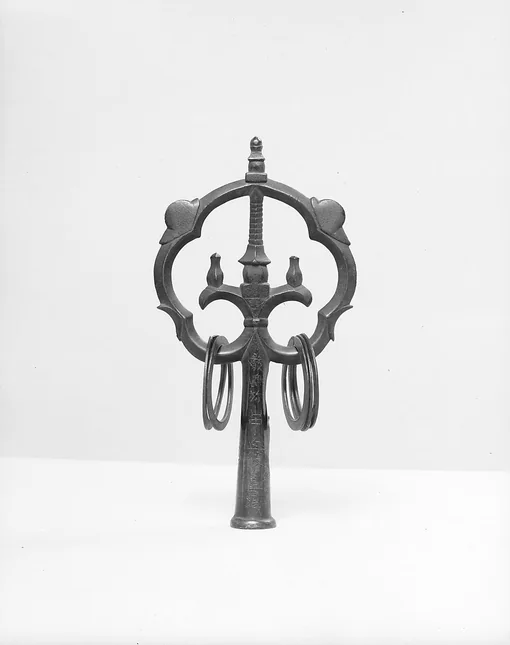
Six loose rings hang from a bronze staff head found on Mount Nachi in Japan. The outer frame divides into two arms with birds’ heads at their tips. This is eighth-century metalwork; lift the staff and you can see where the rings would move. For a Buddhist monk walking in silence they supplied a useful sound. People could hear someone approaching to ask for alms. So could the small creatures on the road, with time to get out from underfoot.
The Japanese name is shakujō. A much later Edo-period example carries an inscription recording a dedication at Itsukushima. In images of Jizō, a Buddhist figure who aids beings in need, the staff accompanies a wish-granting jewel. Its six rings call to mind the six realms in which he offers help. The same rattle that warns a living animal has a place in devotion.
Look for the second dragon
A bishop’s crozier borrows the shape of a shepherd’s crook. It can be identified from the far end of a church. Up close, the Limoges crozier made around 1220–30 gets considerably less pastoral. Saint Michael drives a spear into a dragon. The creature has no wings and its tail opens into a spray of foliage. Michael’s own wings, meanwhile, are in danger: the crook that curves around him turns out to be the body of another dragon, jaws open.
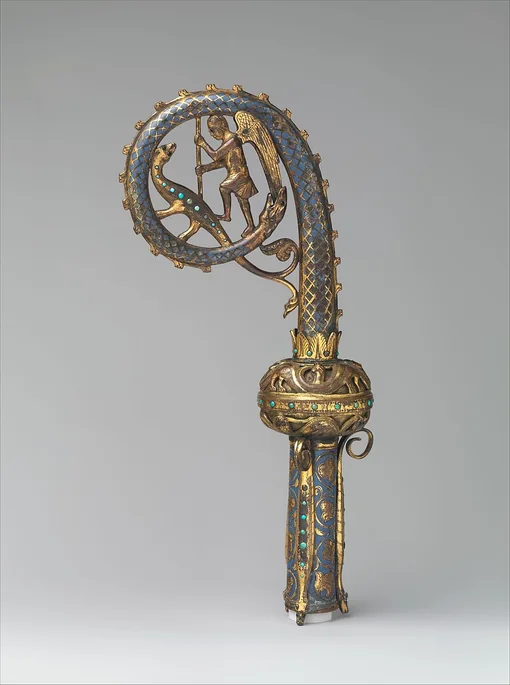
Seen at the scale of a procession, that work identifies the bishop’s office. Held still in the hand, it illustrates Michael’s fight against the dragon in Revelation. That change in viewing distance is worth trying on the photograph: step back, and the shepherd’s hook emerges again.
A rod for each hand
At the coronation of Charles III the orb first went into his right hand, then back to the altar. Before the sceptres arrived, a glove went onto that hand. Next came the cross in his right hand and a dove in his left. The official account of the service records what each meant: the cross signified power and justice; the dove went with equity and mercy. The king stayed seated, holding both.
Those ideas put very different demands on a goldsmith. Robert Vyner made the sceptre with the cross for Charles II’s coronation in 1661. When the jeweller Garrard fitted the Cullinan I diamond in 1911, the existing structure had to be strengthened to hold its weight. The dove on the other sceptre still names its calling without a word.