Who cut the spiral?
The spiral on a wand in the Museum of Witchcraft and Magic was there before a Cornish witch set to work on it. Honeysuckle had wound itself round the growing branch and left its curve in the wood. The witch kept it. At one end is a little goat’s head, painted the colour of copper; silver paint picks out a pentacle and other signs. The finished wand is 55 centimetres long. It was made by the same person who used it.
Another wand at Boscastle lets you read the choice of wood without a label. It is a slim piece of pale oak, dark-streaked, bound with leather at one end. A miniature bottle hangs from it, along with metal acorns, an oak leaf and a whole oak tree in miniature. The maker gave it to the museum with an explanatory sheet. The little tree is a particularly economical way of recording what the big one contributed.
What a handbook can specify
Other makers wanted instructions. In the 1889 English edition of The Key of Solomon, the staff and the wand get separate entries. For the staff the choices are elder, cane or rosewood; for the wand, hazel or another nut tree. In either case, the branch should be one year’s growth. The text specifies sunrise on the day of Mercury and a single cut. The maker is to mark the wood, offer a prayer of consecration and keep the finished implements in a clean place.

The diagrams give the two implements different shapes. The staff is drawn with blunt ends; the wand narrows to a point. Each carries its own set of signs. A person following the book could recognize a mistake before the work was done. The maker of the Cornish wand began with something a printed pattern could never have specified: the exact route one vine had taken up one branch.
What the photographs leave out
At Hollywands, what can’t be seen goes into the workshop record. Anahata carries a raw ruby just above the grip. The wild rose petals are sealed in the lower core, the white fur of Gertie, the wandmaker’s rabbit familiar, in the upper one. In Ajna, mugwort sits in one end of the oak and a whisker naturally shed by Dash in the other.
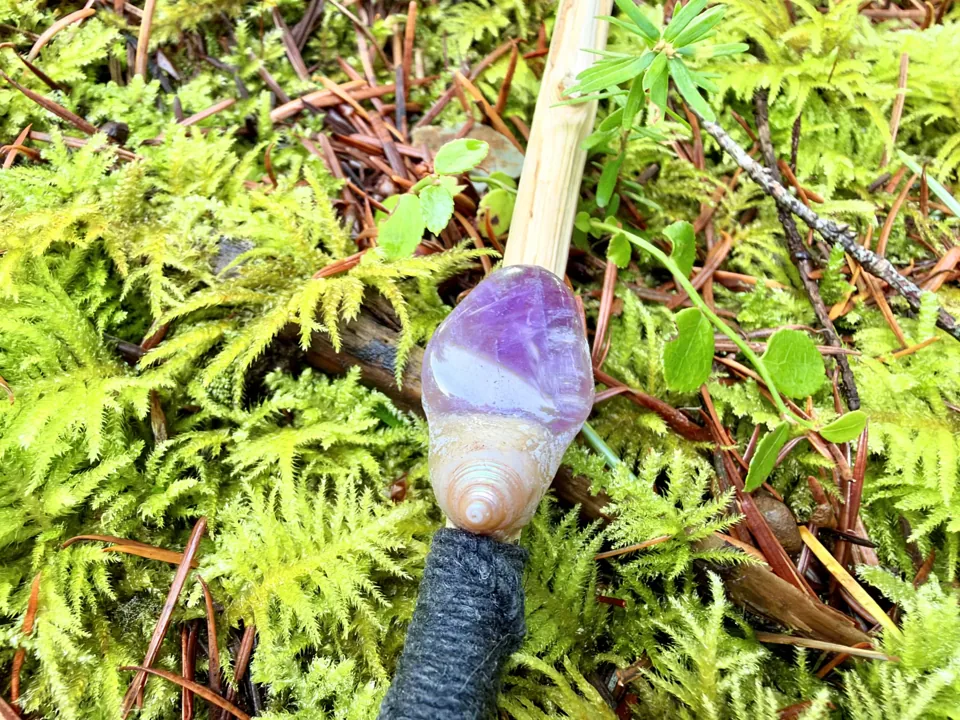
For someone making a wand, this is a useful moment to write a few words down: where the branch came from, what went into the core, whose whisker that was. The next person will see the stone immediately. They’ll need the note for the rest.